
The Path to Precise Knowledge
A procedural note on the Deductive Cycle and its repeated failure to be followed.

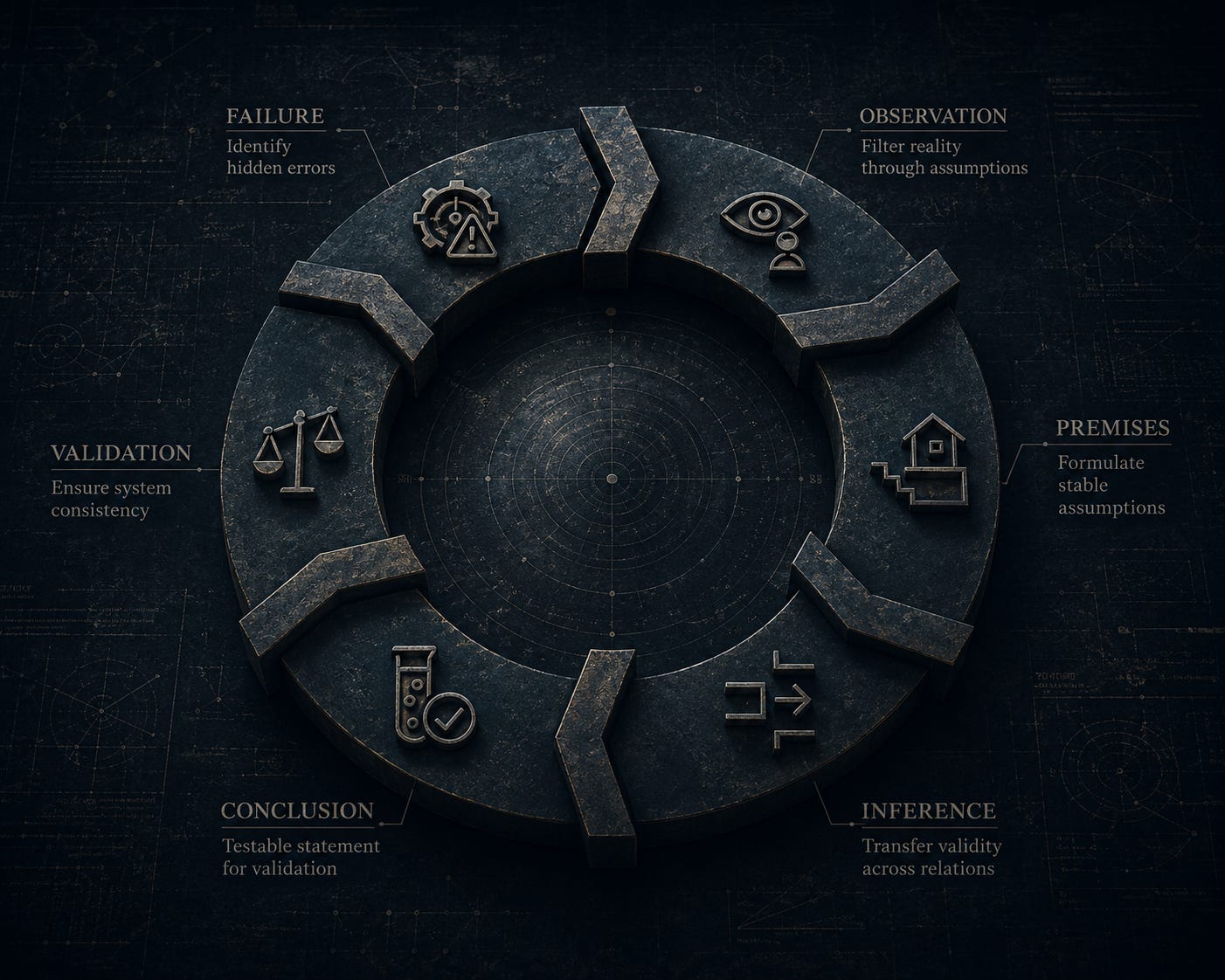
This diagram outlines a system for refining knowledge through deduction. It is not new. It is merely ignored with consistency.
The intended entry point is observation.
Most users begin with premises instead (the perceptual layer having been quietly deprioritized somewhere between convenience and certainty). These premises tend to be unstable. The system notices. It keeps records.
How unexpected.
This article exists to reintroduce sequence and impose minimal order on the process (or, in optimistic scenarios, to return the brain to active duty in matters of observation).
We proceed.
◇ ——— ◇ ——— ◇
Observation
Input is collected from the environment, typically after being filtered through prior beliefs, assumptions, and other forms of quiet distortion (none of which file for permission). This stage is imperfect. It is also non-optional.
Example
The desk lamp does not turn on when the switch is flipped.
Premises
From observation, provisional truths are assembled. They are not required to be correct. Only believed.
Example
If the lamp does not turn on, the bulb may be burnt out, or the lamp may be unplugged.
Inference
Logical relations are constructed. If A or B holds, then C follows. The system performs a computation and presents the result with unwarranted confidence.
Example
If the bulb is defective or the lamp is unplugged, then replacing the bulb or restoring power should resolve the issue.
Conclusion
A testable claim is produced. Without testability, the system quietly downgrades itself to speculation.
Example
The lamp will function after the bulb is replaced or the plug is secured.
Validation
The claim is confronted with reality, which responds without regard for elegance.
Example
The bulb is replaced. The lamp is plugged in. The switch is flipped.
Failure
The least celebrated phase. Also the only one that improves the system.
If the conclusion fails, an inconsistency has been detected. The fault lies either in the premises or in the inference. The system is required to investigate itself. It rarely volunteers.
Example
The lamp remains inactive. Additional causes are considered (power outlet failure, internal wiring defects, quiet sabotage).
◇ ——— ◇ ——— ◇
Why it is a cycle
Failure returns the process to the beginning.
Observation is updated. Premises are adjusted. Inference is recalculated. The system iterates, reluctantly improving with each pass.
Premise → Inference → Test → Failure → Revision.
Repeat until reality stops objecting (which it does not guarantee).
◇ ——— ◇ ——— ◇
On usefulness (a brief administrative note)
Mastery of this cycle produces a particular type of operator: one who does not confuse belief with structure.
Arguments become traceable.
Each conclusion carries its lineage. If challenged, the path is presented without ornament.
Blind spots become detectable.
Decisions reveal their underlying assumptions. When those assumptions fail, the decision is paused rather than defended.
🎭◦◦◦📃◦◦◦🎭
Oh.
That appears to be the end of the visible portion.
Unfortunate.
The remaining sections continue elsewhere, mostly because systems tend to dislike being compressed into feeds designed for celebrity divorces and motivational quotes.
Continue here:
🏛️ — COMPULSORY EXISTENCE PROTOCOL — 🏛️
This concludes the complimentary portion of your observation training. Further materials are available at thedeductivist.com. No prior experience required. Some assembly of worldview may occur.

◦◦◦ 🔍 ◦◦◦
The system expands with attention.
Strong point. Most mistakes happen before the logic even starts.
I’d add one thing: even observation is biased. We don’t see reality “as it is,” we see it through our assumptions.
Still, the key idea holds—failure isn’t the end, it’s feedback. That’s how thinking actually improves.
"the objective is no longer to be correct, but to locate what is correct" does most of the philosophical work. It also resolves a tension the diagram leaves open.
If observation is filtered through prior beliefs (as you note in the first stage), then observation is the exit of a previous cycle. The diagram is a spiral, not a circle, and there's no clean place to start. Every "fresh" observation arrives already pre-shaped by premises that earlier failures revised, which were themselves drawn from observations pre-shaped by earlier premises, and so on backward. That's fine, it just changes what the cycle is for. If the goal were "to be correct", the impurity of the entry point would be a fatal problem. If the goal is to "locate what is correct", the impurity is the engine. Each pass corrects a little, reveals a little more of what observation was missing, and feeds back into the next pass. The cycle never closes because it isn't supposed to. That's the operational distinction.